Custom digital solutions
We design and build custom digital solutions for health and care, and for anyone whose work touches it. Web tools, live dashboards, data capture and audit tools, and desktop and mobile apps for Mac, Windows, iPhone and Android. If your problem involves workflow, data or reporting, we can almost certainly build the tool that solves it. Because we deliver improvement programmes ourselves, we build for the realities of frontline work, poor connectivity, mixed digital confidence, and governance that has to stand up to scrutiny.
Recent builds
Practice Improvement Programme Platform
A secure, offline-capable platform that captures a general practice's whole improvement journey in one place, aligned to the national Modern General Practice self-assessment, with a live dashboard across every practice and cohort for the commissioning organisation.
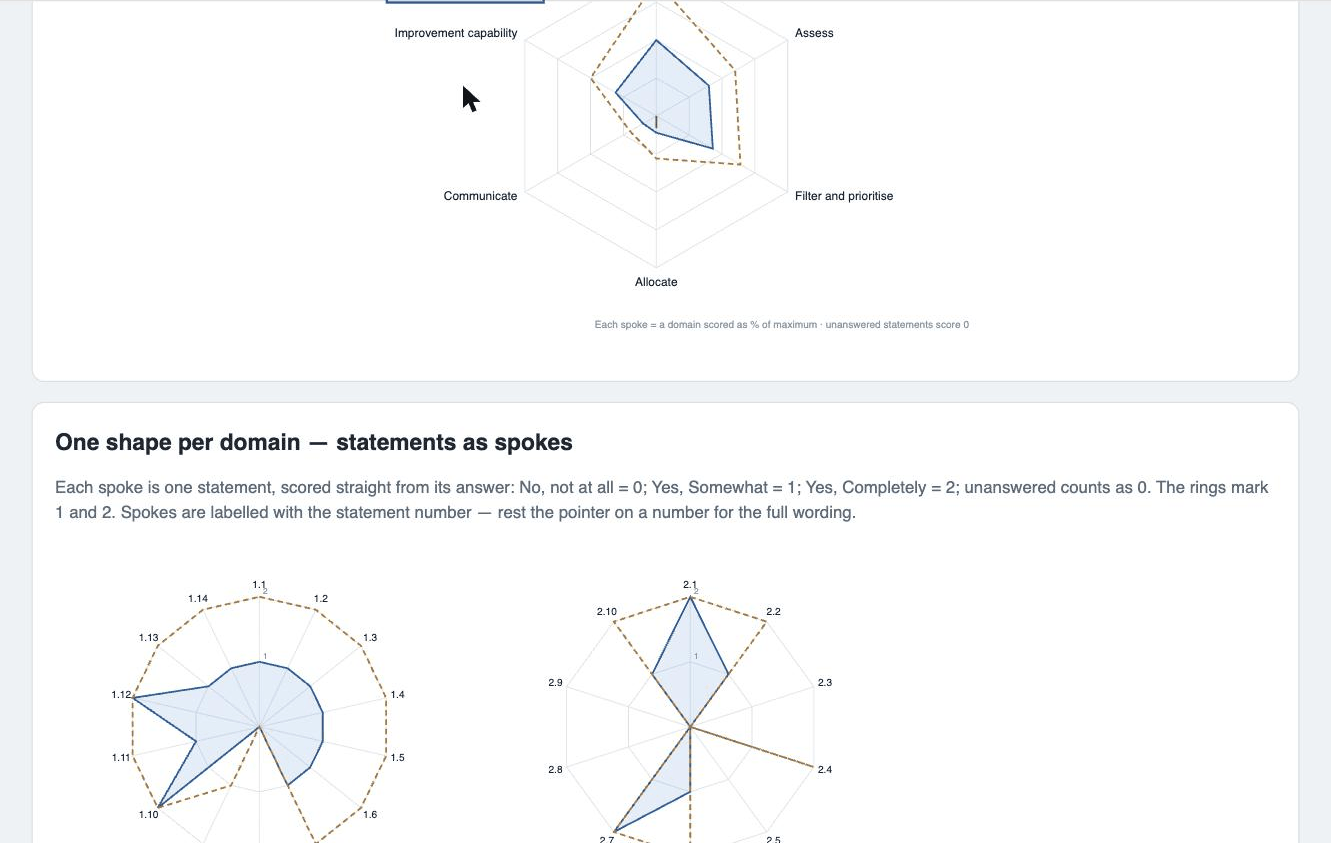
Want to see the quality of what we build before you talk to us? The three free tools below are open to everyone. Have a problem that needs a tool? Tell us the problem, not the specification. Start a conversation.
Analysis tools
Practical, browser-based tools we've built from our own programme work and are sharing for others to use. They run entirely in your browser, with no account, and no data is shared using these tools.
Want one of these run properly across your service?
The tools are free because a team should be able to answer these questions on its own. When the question needs answering across a whole service, we configure the work to your structure, run the fieldwork, and write up findings your organisation can act on. We also design bespoke audits and improvement programmes from the ground up.
Start a conversationHidden Work Audit
A free audit for adult social care teams. Measure how much registered practitioner time goes on work that does not need a registered practitioner, topping up an electricity card, chasing a hospital for a follow-up, arranging blister packs, and record where each task actually came from. Built from a survey of 23 practitioners at a city council, it turns your own figures into the case for giving that time back to practice. Free, no sign-in, and your answers never leave your browser.

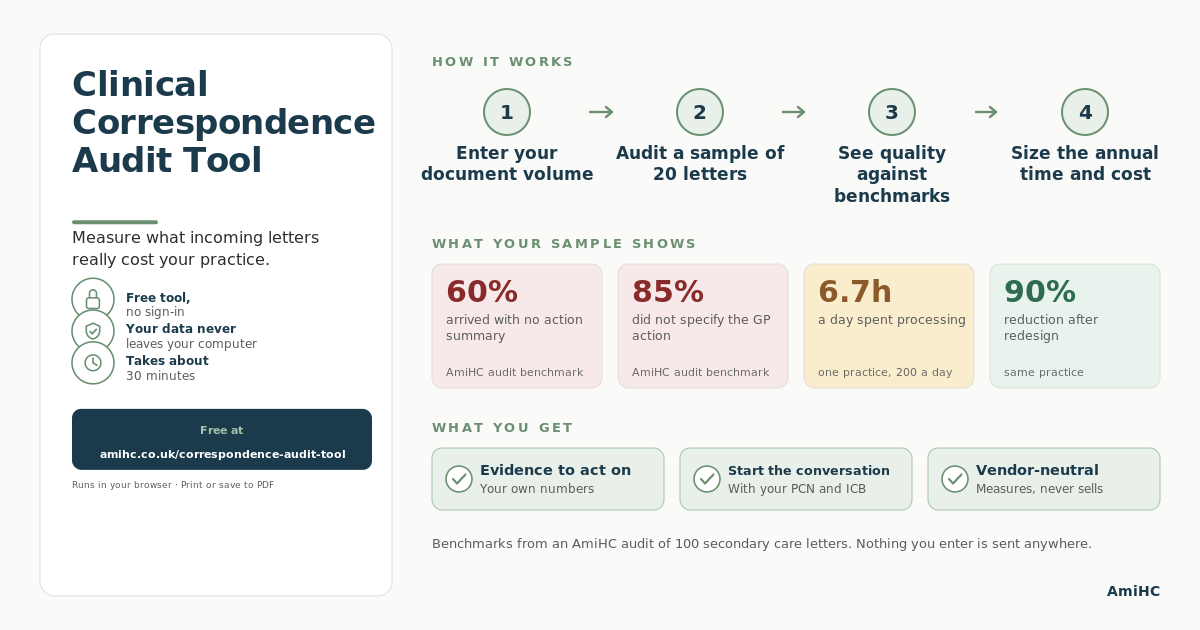
Clinical Correspondence Audit Tool
Sample 20 letters and find out what incoming correspondence really costs your practice in time, money and avoidable patient contacts. Benchmarks your results against our own audit findings, and stays vendor-neutral: it measures the problem rather than selling a solution.
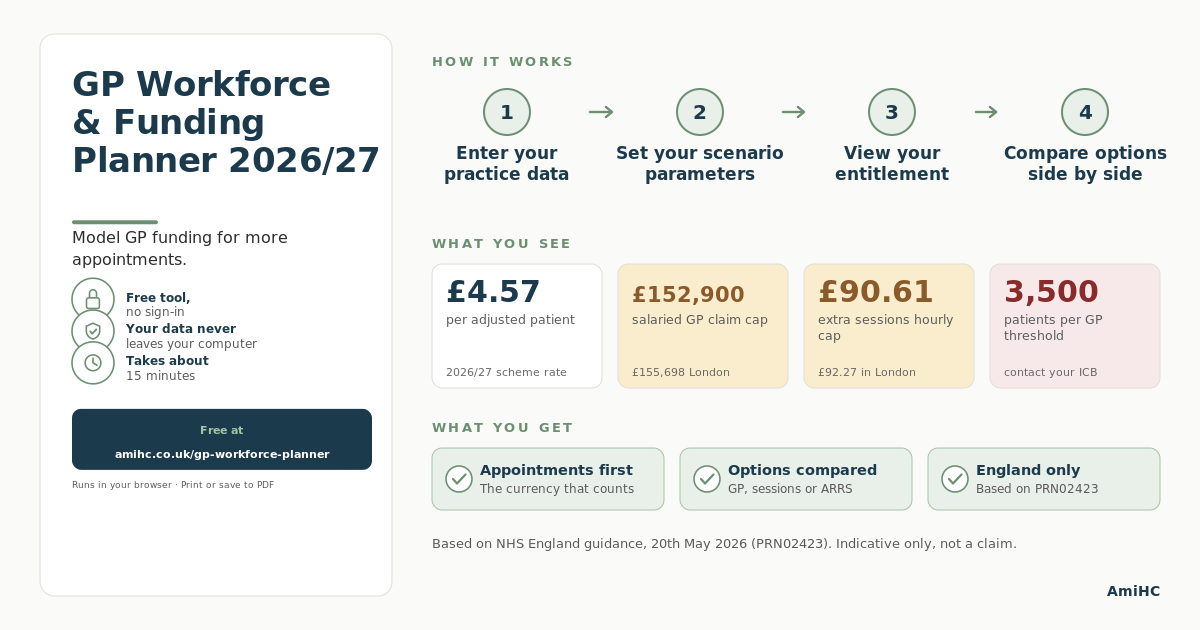
GP Workforce & Funding Planner
Work out your practice's entitlement under the 2026/27 GP reimbursement scheme (England), compare hiring a new salaried GP with funding extra sessions, and see what each option adds in appointments per week.
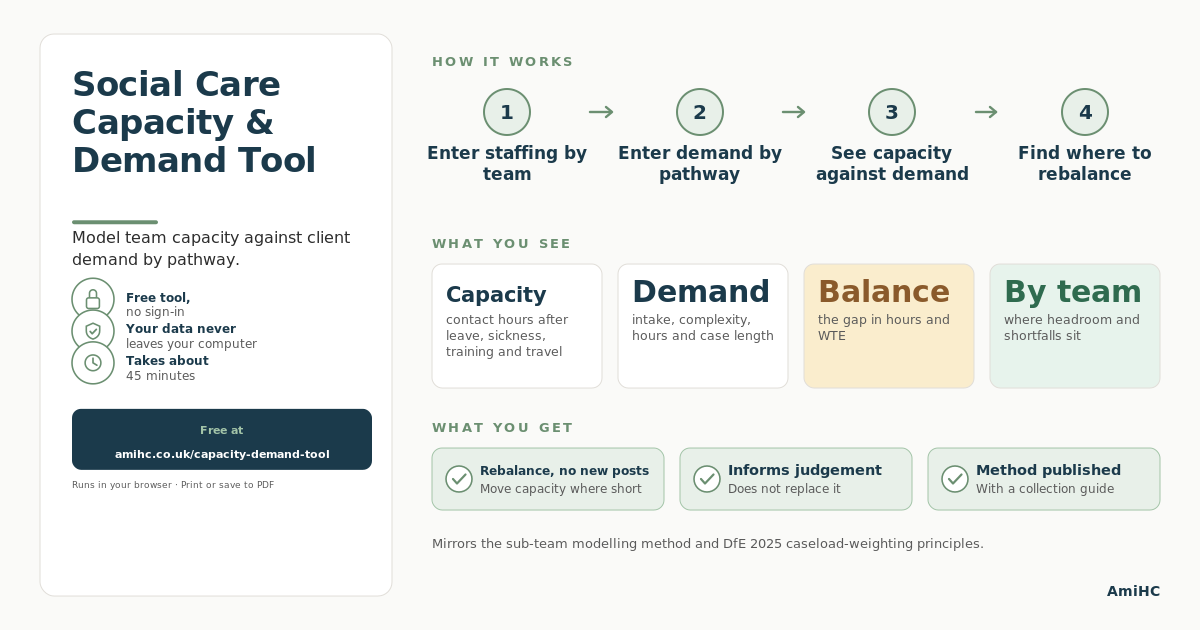
Social Care Capacity & Demand Tool
A free social care capacity and demand tool. Model a team's client-contact capacity against demand by pathway, see at a glance which teams are over or under pressure, and test how rebalancing would help. Comes with sample data to explore, and you can save, export and print your own model to PDF. A companion guide explains exactly what data to collect and how.
What we do
We combine practical, embedded quality improvement with rigorous programme management to deliver measurable change in primary care, social care, and the interfaces between them.
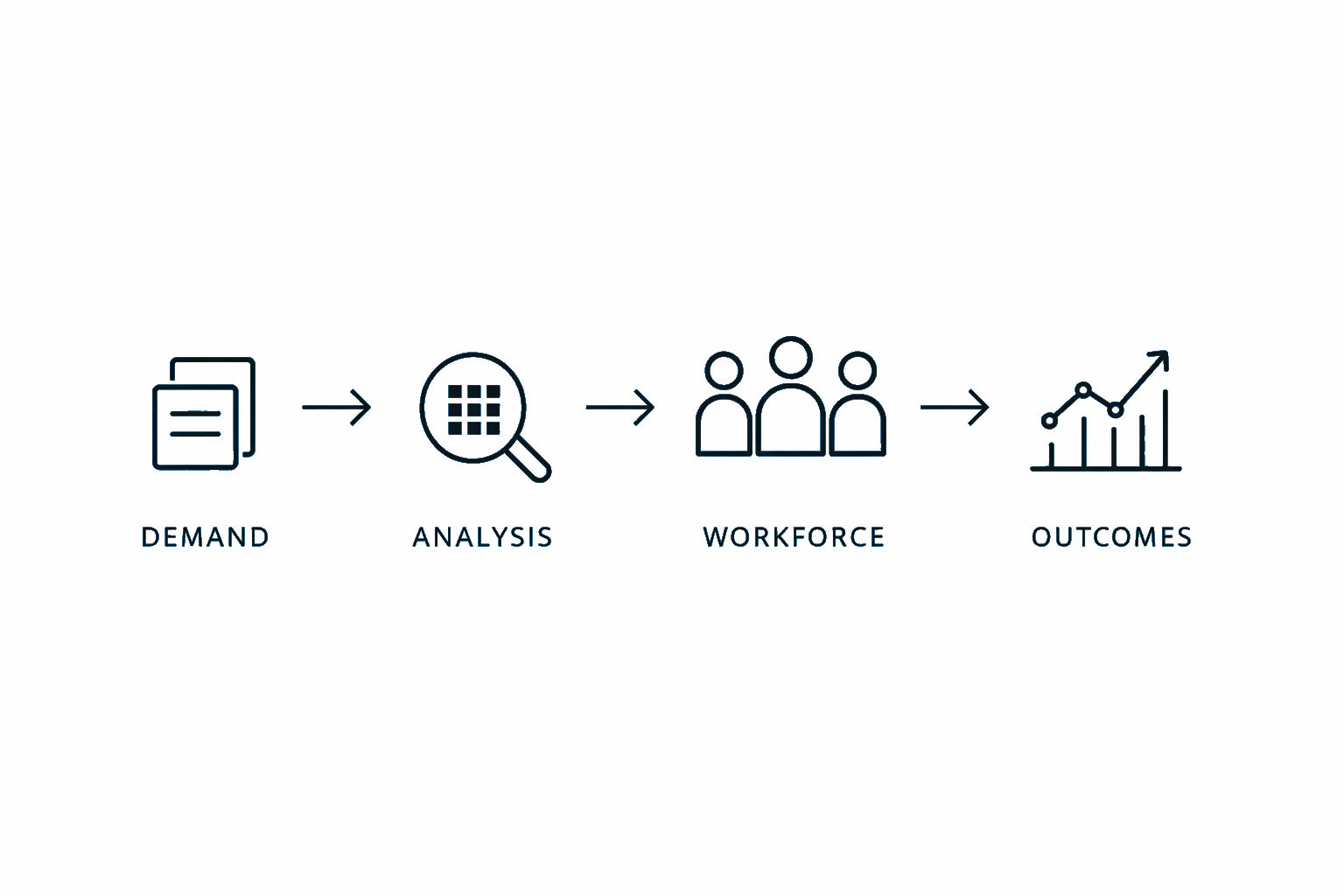
Quality improvement facilitation
We work on-site with practice teams to identify where time is being lost, redesign the workflows that cause it, and build the team's capability to sustain changes independently. Our approach is grounded in Lean Six Sigma methodology, but it's practical and hands-on: we sit in duty rooms and observe real operations rather than requesting data extracts from a distance. Typical engagements run from 12 to 20 weeks of embedded support, covering areas such as care navigation, electronic repeat dispensing, document management, patient access pathways, and long-term condition reviews.
Primary careProgramme management and oversight
We manage multi-practice improvement programmes on behalf of commissioners, providing the coordination, reporting, and quality assurance that keeps large-scale transformation on track. This includes commissioner liaison, facilitator mentoring, cohort-level learning events, and the kind of structured governance that ensures programme outcomes are documented and demonstrable. We've managed programmes commissioned by NHS England and RCGP, working through specialist delivery partners.
Commissioners & ICBsService transformation
Beyond individual practices, we design and deliver improvement programmes that work across organisational boundaries: between primary and secondary care, between health and social care, and between commissioners and providers. Our hospital team improvement methodology applies Lean Six Sigma to discharge pathways, care transfers, and demand management with quantified cost avoidance and capacity release.
In adult social care, we work with local authorities on invest-to-save transformation, supporting the investment case, benefits realisation, governance, procurement, information governance, and workforce change. This includes technology-enabled care programmes that aim to reduce reliance on traditional care while improving outcomes for older adults and people with learning disabilities, delivered on MSP principles and co-produced with people who draw on care and support.
Health & social care systemsCustom digital solutions
We design and build secure digital tools for health and care organisations: web tools, live programme dashboards, and desktop and mobile apps. Every build starts from the operational reality we know first-hand, so tools work offline where connectivity is poor, meet people at their level of digital confidence, and hold up to information governance scrutiny. Whatever the problem, if it involves workflow, data or reporting, we can build for it. Recent builds include a practice improvement programme platform, a clinical correspondence audit tool, a GP workforce and funding planner, and a capacity and demand modelling tool.
Health & care organisationsEvidence of impact
Every engagement we deliver is measured, with figures calculated from timed observations, patient volumes, and verified workflow data. The 10,100-hour headline is a running total of annualised savings documented across every engagement since 2022, not a figure for any single year, and the case studies below are a selection from that work rather than the full ledger. The full working, engagement by engagement, is available to commissioners on request.
How these figures are measured
Time savings start with direct observation: we time real tasks in real settings, count actual volumes from practice systems, and verify workflows with the people who run them. Weekly figures are annualised using each organisation's own working pattern, typically 46 working weeks, so annual figures are extrapolations from measured baselines rather than estimates. Where a saving depends on a change that is agreed but not yet embedded, we report it as anticipated rather than implemented, and we distinguish cashable savings from capacity release throughout. Every published figure has a working behind it that the commissioning organisation has seen.
Lincolnshire — Practice Level Support programme
5,455 hours/year releasedFour practices received embedded quality improvement support over 20 weeks, targeting document management, electronic repeat dispensing, care navigation, and long-term condition review pathways. One practice alone released 2,868 annualised hours through measured workflow changes across clinical and administrative tasks.
London — Document workflow transformation
90% time reductionA detailed audit of clinical correspondence processing revealed a practice was spending 6.7 hours daily on secondary care document handling. Through workflow redesign and role redistribution, processing time was reduced to 40 minutes per day. A parallel audit of 100 secondary care letters found 60% lacked action summaries and 85% had no documented GP action, identifying over 13,000 misdirected patient enquiries annually.
South Yorkshire — GP capacity release
670 minutes/week savedAt a 30,000-patient practice, document workflow redesign alone released 670 minutes of GP time per week, equivalent to approximately £40,000 annually in clinical capacity. This was achieved through targeted changes to how incoming correspondence was triaged, actioned, and filed, without additional technology or staffing.
West Yorkshire — Telephony and access
52% increase in call capacityReconfiguration of telephony systems, call handling protocols, and appointment booking workflows increased weekly call capacity from 1,508 to 2,302 calls while maintaining answer rates above 80%. A separate practice improved its answer rate from 45% to 62% through process changes alone: no new phone lines, no new staff.
Derbyshire — Targeted rapid improvement
360 hours/year from 4 initiativesFour focused improvement initiatives at a single practice (electronic repeat dispensing, care navigation, medication review alignment, and document handling) collectively released 360 annualised hours. One initiative eliminated 4,000 duplicate annual transactions by consolidating long-term condition and medication review processes.
Clinical correspondence quality programme
A dedicated research and improvement programme addressing one of primary care's most persistent operational challenges: the volume, quality, and safety impact of clinical correspondence.
General practices across the country are drowning in clinical correspondence that arrives in inconsistent formats, with unclear expectations, and without adequate systems to process it safely. The consequences are real: missed actions, delayed care, wasted GP time, and thousands of patients contacting the wrong service because their letters don't tell them what happens next.
We're building an evidence base across multiple sites to quantify these problems and develop practical, scalable solutions. Our audit methodology measures processing times, error rates, and workflow impact at the practice level, producing data that commissioners can act on.
This programme sits at the intersection of patient safety, operational efficiency, and national policy, aligning with the NHS Red Tape Challenge and the findings of recent HSSIB investigations into the primary-secondary care interface. We're exploring academic collaborations to develop a formal research application alongside the service improvement work.
About
AmiHC is led by Paul Friend, an independent quality improvement specialist and programme manager with deep operational experience in NHS primary care and health and social care systems. Since 2022, Paul has delivered embedded QI facilitation and programme management across more than 34 general practices across eight ICB areas in England, plus Northern Ireland, working on programmes commissioned by NHS England and the Royal College of General Practitioners, delivered through specialist partners including Conexus Healthcare, Shil UK, and Develop Consulting.
What sets Paul apart is the way he works. Rather than consulting from a distance, he embeds with practice teams, typically four days a week during intensive phases, scaling back as capability transfers. He sits in duty rooms, observes real workflows, measures actual task times, and builds changes around what he sees rather than what he's told. Every improvement is measured, every outcome is documented, and every engagement leaves teams with the knowledge to sustain changes independently.
From May 2026, Paul is senior programme lead on Nottingham City Council's Technology Enabled Care (TEC) Demonstrator, working as part of the council's programme team. The demonstrator is an invest-to-save programme testing how technology can improve outcomes and reduce reliance on traditional care for two groups: older adults receiving home care, and adults with learning disabilities in supported living. The programme has Executive Board approval and is moving into mobilisation, working towards a September 2026 go-live.
Run on MSP principles, the programme spans the full programme lifecycle: governance design; a benefits realisation model that separates cashable savings from cost avoidance; information governance and DPIAs; procurement of a proactive monitoring platform; redesign of referral pathways into the council's case management system; co-production with people who draw on care and support; provider partnerships across the home care and supported living markets; and workforce engagement and culture change. It is designed as a rehearsal for business-as-usual adoption, leaving the council a tested pathway, evidence base and rollout toolkit rather than a standalone pilot.
Our associates
AmiHC draws on a network of experienced associates who bring specialist expertise to each engagement as the work requires. This means we can scale to meet programme demands without carrying overhead: you get the right people, for the right work, at the right time.
Lean and Six Sigma
Experienced Lean and Six Sigma practitioners who bring structured improvement methodology to complex operational challenges, from frontline process redesign through to organisation-wide transformation.
Data and analytics
Analysts who can extract meaning from operational data, build dashboards, and produce the evidence base that commissioners and boards need to act on.
HR and workforce
Specialists in workforce planning, role redesign, and the people side of change, essential when improvement work involves new ways of working or skill-mix changes.
Finance
Professionals who can model cost avoidance, build business cases, and ensure that efficiency gains translate into demonstrable financial outcomes.
Practice management and operations
People who have run practices and understand the day-to-day realities of primary care operations, bringing credibility and practical insight to every engagement.
Clinical and operational leadership
Senior leaders who can provide strategic oversight, clinical governance, and the organisational authority that large-scale programmes require.
What people say
All quotations below are taken from written feedback held on file. Words are the author's own. Cuts are marked with an ellipsis, punctuation and obvious typing errors have been tidied, and client names have been removed. We do not publish client names on this site.
"It's a good news story. […] I wanted to let you know because all of this is your hard work, thank you!"— Head of Service, adult social care, local authority
"The practices participating had significant challenges and I can say that having Paul's role supporting these teams has helped to progress the work at a pace and keep these teams participating in the work when they may have found it easier to drop out rather than stay to the end and implement their recommendations."— Development Adviser, Primary Care Transformation Team, NHS England
"One of these major changes was transforming our appointment booking process and moving to a total triage model. This was a massive move for the practice and amazingly something we were able to pull off successfully at the first attempt. […] Having Paul on board has been a real catalyst for change."— GP Lead, 30,000-patient practice
"We have found Paul's input and involvement in the Time for Care work to be invaluable. […] Without Paul's input there would have been a far greater strain on our staff's time, and we may not have decided to extend the programme past the initial stages."— Practice Manager, Wakefield
"There was an initial reluctance to get involved due to how much pressure we are under but with Paul's enthusiasm, local knowledge, time and support we have been able to show some really positive outcomes in terms of time and money saved without a huge time commitment from our management team. […] I believe that the PGP programme would not be so successful without this additional, local, practical support."— GP Partner, Wakefield
"Having Paul as a mentor has been fantastic, his support helped us turn ideas into reality. The protected time each week made a huge difference, giving us the space to work on mini-projects and pull together information for everyone in the team."— Practice Manager, six-month improvement programme, March 2026
"You have encouraged and empowered us to not be afraid to look, to ask and to try! […] Having you in the practice every week gave leverage to the changes we wanted to make, however small they were in the beginning. […] We would recommend any practice to take part in this programme."— Practice improvement team, Lincolnshire
For commissioners and procurement teams
We do not publish client names, case detail or attributed quotations on this website. Our clients are NHS practices, integrated care boards and local authorities, and their operational data is theirs, not ours to advertise.
What we will provide on request, directly to a named commissioner or procurement officer:
- Named referees, with permission sought from the client first
- Full attributed versions of any quotation on this page, with the source correspondence
- Detailed case studies, including the underlying measurement and how each figure was derived
- Insurance, information governance and company documentation for pre-qualification
Email paul@amihc.co.uk with the organisation you are asking on behalf of and what you need to see.
Work with us
Whether you're commissioning a service improvement programme or looking for an experienced programme manager to join your team, there's a way to work together.