
1 · Your practice and your document volume
Everything stays on this device. Figures update as you type. If you do not know a number, estimate it and mark the assumption.
2 · Audit your sample 20 letters
Take the next 20 pieces of clinical correspondence that arrive, or 20 consecutive letters from a recent day, and tick what is true of each. Leave a box unticked where the letter did not meet that test. For the final column the opposite applies: tick it only if that letter needed chasing. The point is not to be exact, it is to see the pattern.
| Letter | Action summary clearly states what the practice must do |
GP action specified specific and actionable, not "please follow up" |
Correctly directed should have come to the practice at all |
Patient told next steps letter says who does what and when |
Needed chasing clarification call or message required |
|---|
3 · What your sample shows
Your results against findings from AmiHC audits of secondary care correspondence in general practice.
4 · What it costs you
Your sample percentages applied to your annual document volume.
5 · What could be recovered
Modelled on the assumption that a letter arriving with a clear action summary takes less time to process, and that a letter telling the patient what happens next generates fewer avoidable contacts. Adjust both assumptions to match your own experience.
6 · Where to start
Method, benchmarks and sources
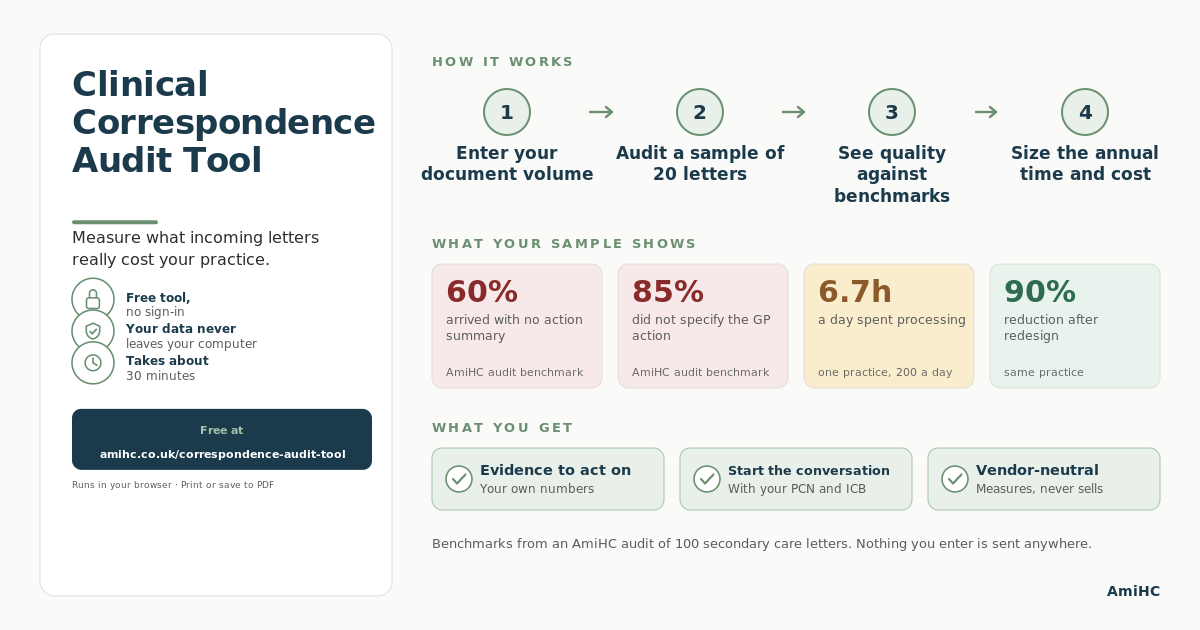
- Benchmarks. The comparison figures come from an AmiHC audit of 100 consecutive pieces of secondary care correspondence at a general practice in London: 60% arrived without a summarised action for the practice, and 85% had no clearly documented action for the GP. That practice was processing around 200 documents a day, taking about 6.7 hours of staff time daily, equivalent to about 40 ten-minute appointments.
- What redesign achieved there. Requiring an action summary at the top of each letter, together with workflow redesign and role redistribution, reduced daily processing from 6.7 hours to about 40 minutes. That is a 90% reduction in a single practice, and it should be read as what became possible there rather than as a figure any practice should expect.
- Avoidable patient contacts. At the same practice, correspondence that did not tell patients what would happen next was associated with more than 13,000 misdirected enquiries a year. This tool does not assume that rate. It asks you to set your own, defaulting to a deliberately conservative 25% of letters lacking next steps.
- Cost assumptions. The GP hourly default of £90.61 is the national cap on additional session cost per hour under the 2026/27 GP contract (NHS England, PRN02423, 20th May 2026), used here as a defensible proxy for the value of GP time. The admin default of £16 an hour is an approximate mid-band cost including on-costs. Change both to your own figures.
- Sample size. Twenty letters is enough to reveal a pattern and start a conversation. If a number will be used to support a business case or a formal escalation, audit 100 and treat this as the pilot.
- Scope. This tool measures incoming clinical correspondence in general practice in the UK. It is deliberately vendor-neutral and models no particular product. If you are considering document automation software, running this first gives you the independent baseline to judge any supplier's claims against.
- Wider context. The volume, quality and safety impact of clinical correspondence sits at the intersection of patient safety and operational efficiency, and aligns with the NHS Red Tape Challenge and HSSIB investigations into the primary and secondary care interface.